The first cybersecurity tool most people install is a SIEM. A SIEM without the fundamentals is a dashboard full of alerts you cannot interpret.
The pattern repeats: someone decides to get into cybersecurity, reads a list of enterprise tools, installs a Splunk trial or a commercial EDR, stares at it for two weeks, and concludes that security work is too complex to break into. The tool was not the problem. The sequence was.
Five things cover 80% of what entry-level security work actually requires.
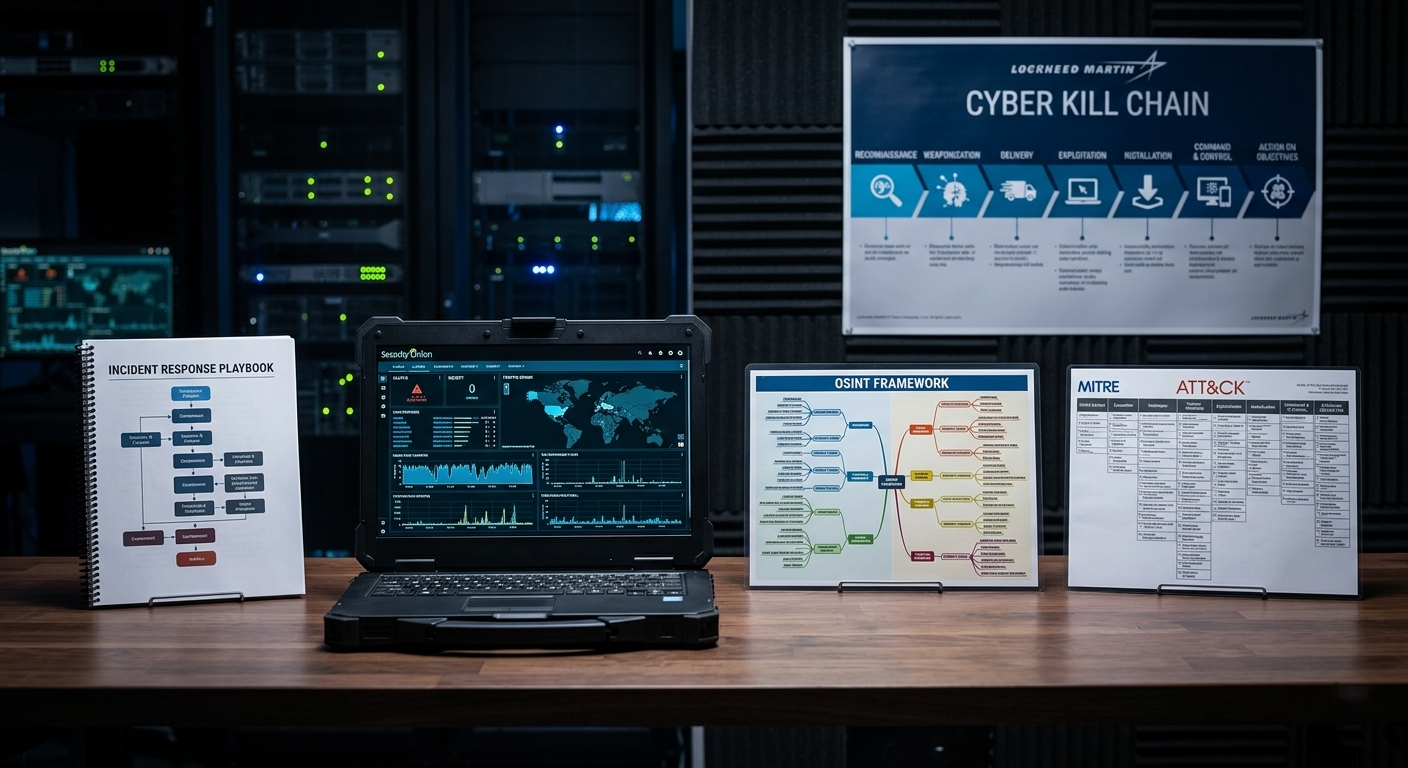
A written playbook. Before any tool, you need a documented process for what to do when something happens. What do you check first? Who gets notified? What counts as an incident versus noise? A playbook costs nothing to write and most people skip it because it is not a tool. That is exactly why their other tools produce confusion instead of answers.
Security Onion. One platform that integrates Wireshark for traffic capture, Snort for intrusion detection, the Elastic Stack for log analysis, and OSSEC for host-based monitoring. You do not need four separate installations. You need to understand what each component is doing and why. Security Onion puts them in one place and gives you a working environment to learn in.
The OSINT Framework. A mapped collection of open-source intelligence resources organized by investigation type. When you are looking at a domain, an IP address, an email, or a username, this is where the workflow starts. Free, community-maintained, and more comprehensive than most people realize until they actually use it.
MITRE ATT&CK. A knowledge base of adversary tactics and techniques built from documented real-world incidents. When you are trying to understand what an attacker did and what they are likely to do next, this is the reference. Learn to navigate it before you need it under pressure.
The Lockheed Martin Cyber Kill Chain. Print it and put it on the wall. Seven stages: Reconnaissance, Weaponization, Delivery, Exploitation, Installation, Command and Control, Actions on Objectives. Every incident maps somewhere on this chain. Knowing where an attacker is in the chain tells you what to look for next and what they have already done.
The tools to skip until you have outgrown those five: enterprise SIEMs and commercial EDRs. They require process maturity, trained staff, and infrastructure to produce useful output. Handing an entry-level analyst a commercial SIEM without the foundational knowledge above does not accelerate learning. It produces alert fatigue and discouragement.
One note on Wireshark specifically. Traffic capture is the obvious use. The less obvious work, following TCP streams to reconstruct sessions, decoding protocols to see what is actually inside a packet, identifying anomalies through retransmission patterns and unexpected resets, is where real investigation happens. Wireshark is not a beginner tool you graduate past. It is a practitioner tool that gets more useful the deeper you go into it.
Start with these five. Add complexity when you have outgrown them. Most people never outgrow them because they started with the enterprise tools and never built the foundation.
If you are mapping the gap between where you are now and where you need to be for an entry-level security role, the Cybersecurity Career Roadmap covers that for $47. Cybersecurity Career Roadmap
Written by Mario Martinez Jr. (ku5e / Gary7) | TryHackMe Profile | ku5e.com/blog