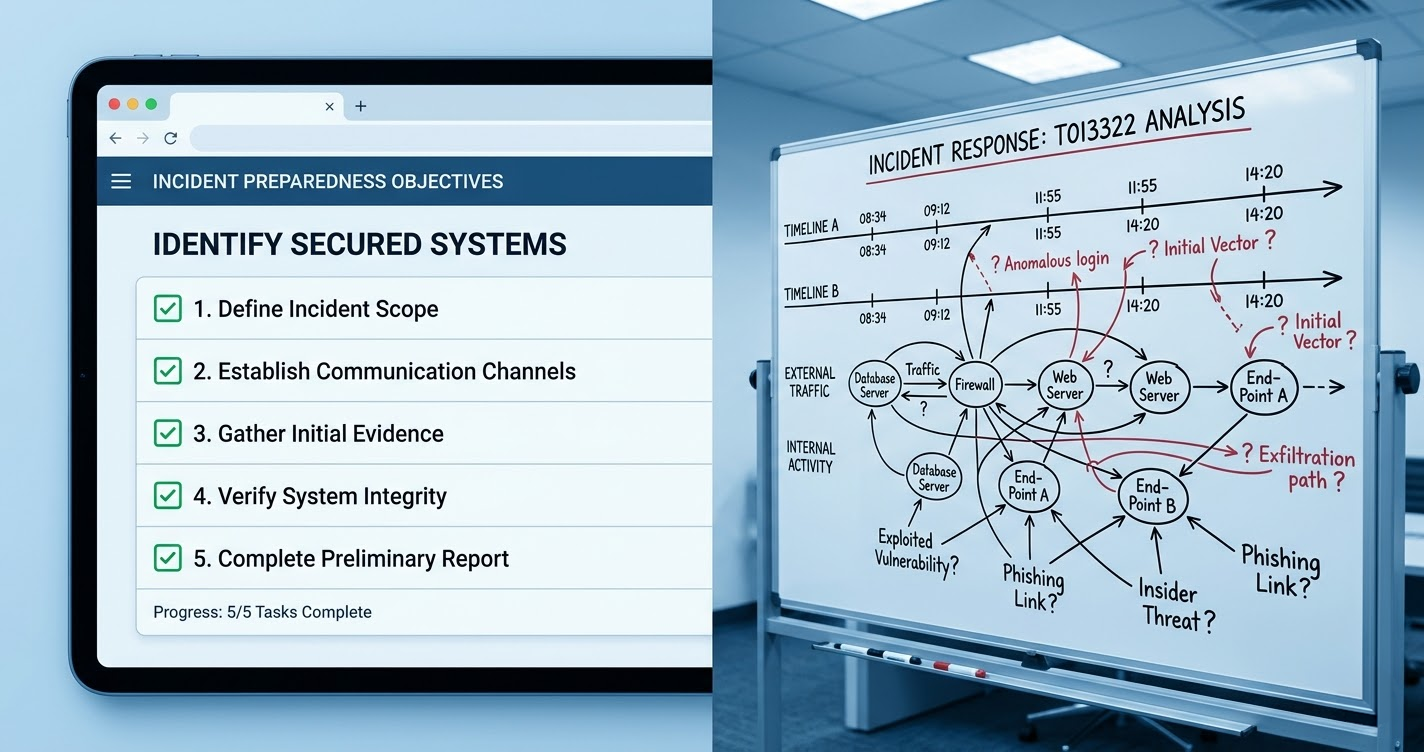
During Advent of Cyber, a room felt manageable — not because the concepts were simple, but because the room told you which system to examine, confirmed that a threat was present, and guaranteed that completing the steps would surface an answer. That structure is useful for learning. It is also the exact thing that disappears in a real investigation.
The gap between TryHackMe and real incident response is not difficulty. It is the absence of a defined answer.
Every TryHackMe room starts with a target and a question. The question implies that an answer exists. Following the correct process surfaces it. Real incident response starts with a report, an alert, or a user complaint, and the investigation does not confirm upfront whether there is something to find, how far the compromise extends, or whether the first thing you find is the primary cause or a symptom of something deeper.
The IR module I worked through this year made this concrete. The Identification and Scoping room involved a phishing incident at a fictional financial services company. One user reported the email. The room directed you to look for a second user who received the same email and never opened a ticket. You found her in the ticket thread. A real investigation does not tell you a second user exists. You look, or you do not. If you skip that step, she remains compromised and the scope stays wrong.
The Eradication and Remediation room took it further. The compromised system was a Linux server running Jenkins. The initial access vector was a reused password on a service account. Inside Jenkins, the admin panel was using default credentials. Inside the file system, a backup script was already staged, configured to send data to an external IP. Three separate failures enabled the compromise: a reused password, default credentials, and a planted exfiltration mechanism that had not yet fired. Each one alone is a containment problem. Together they represent a different class of incident with a different remediation sequence. Rooms generally lead to one clean finding. Real incidents compound.
The rooms are worth doing. They build vocabulary, tool familiarity, and the discipline of working through an investigation without shortcuts. The thing to add is the habit of asking what else might be there after the first finding. In a real incident, the first confirmed compromise is a starting point. The second root cause is what determines whether the incident closes or reopens.
If you are building a study plan that moves from rooms to real-world readiness, the Cybersecurity Career Roadmap is $47.
Written by Mario Martinez Jr. (ku5e / Gary7) | TryHackMe Profile | ku5e.com/blog